
The Lively Blog
SIGN UP FOR OUR
Newsletter
Stay up to date on the latest news delivered straight to your inbox
The Evolving Standard of Health Benefits
Alex Cyriac · April 25, 2026 · 9 min read
When I look at the history of health benefits, the same gap keeps showing up. Employers set out to offer something valuable, but employees often experience confusion, delay, and uncertainty when they try to use what they have been given. I have seen employees get stuck because they do not understand their plan, but also because the tools around that plan were never designed for how people actually live and make decisions. For years, "service" in the health benefits industry meant a person manually moving data from one system to another, which created the delays and ticket queues that many people now assume are just part of having benefits.
We are finally at a point where technology, and AI in particular, can change that standard. The information inside a benefits system can move at the same speed as the people who rely on it, instead of being locked behind forms, spreadsheets, and manual reviews. The question is not whether AI can do this, but whether we choose to use it in a way that actually improves the experience for employees, HR teams, and brokers, rather than just making the underlying operation more efficient.
Intentional ownership is the foundation of AI
When I think about AI in health benefits, I do not start with the technical details. I start with the intent behind the system and who it is ultimately built to serve. AI now shapes which information people see when they make choices and how quickly routine tasks move through the system. The structure of the underlying technology determines whether that power is used to reduce friction for people or simply to push more volume through the same process.
Many HSA and FSA providers in this space license their core platforms from third parties in a white-label model. That approach helps them manage overhead and get to market quickly, but it also creates a layer of distance between the people using the system and the people who can actually change it. When something is confusing or slow, feedback travels through that entire chain before anything can be fixed, if it gets fixed at all. AI added on top of that kind of platform is usually limited to answering questions about the system rather than improving the system itself.
When Shobin and I started Lively, we made a different choice. We decided to be a purpose-built provider and own the technology stack end to end so that when something is not working for an employer or an employee, we can fix it directly instead of passing the issue along to another platform. If an employee cannot complete a simple task, or if an HR team is stuck doing manual work that software should handle, we want that problem to land with us, not with a middleman.
That ownership matters even more in an AI world. When AI is built into the main system that runs the benefit, it can do the work itself instead of only answering questions about how the system works. It can update eligibility, fix data, order cards, and support workflows in real time, because it is operating inside the same system that stores the truth of the program. That is the difference between AI that only talks about the system and AI that actually removes work from employees and HR every day.
For a deeper look at how we are using AI in these day-to-day moments, you can read a recent interview with our Co-Founder and COO, Shobin Uralil, about how agentic AI is changing the member and employer experience.
Bridging the gap between having a benefit and using it
One of the clearest examples of how this plays out is Open Enrollment. Every year, employees are asked to make high-stakes financial decisions in a short period of time. In most companies, benefits are the second-largest expense after payroll. For the employee, choosing a plan is both a financial and health decision, yet they are usually doing it with very little personalized data.
The result is familiar. Employees default to the plan that feels safest on paper, sometimes the most expensive option, because the tradeoffs are hard to calculate. Others guess and hope they will not regret it later. HR teams then spend weeks answering the same question in different words: "Which plan is better for me?"
We built decision support directly into the Lively platform to solve that specific problem. Instead of asking employees to run complex calculations on their own, we let them describe their expected healthcare needs in terms they understand. The AI then runs the math in the background and shows them what each plan would likely cost over the year, including premiums, out-of-pocket expenses, and tax advantages, tied to the kind of care they expect to need.
The goal is not to have AI choose a plan on someone's behalf. The goal is to turn a stressful choice into a clear, informed one. When a person can see the projected financial impact of each option in front of them, they are no longer guessing. They are making a choice they can explain to themselves and to their family. The real test of that confidence, though, does not end at enrollment. It shows up when someone actually uses their benefits and submits a claim.
Building confidence through claims
Claims are the moment where theory meets reality. An employee has already paid for something, and now they are waiting to see whether the system will support them in the way they expected. Even when the majority of claims are straightforward, some programs still rely on slow, manual reviews across multiple systems. That can lead to longer review times, uncertainty for the employee, and more "Where is my reimbursement?" questions headed toward HR.
We use AI in our claims experience to remove as much of that friction as possible. When someone uploads a receipt, the system reads it in real time, checks for duplicates, looks for missing information, and compares the expense against eligibility rules. If there is a problem, the person sees it immediately and can fix it in the moment, instead of discovering it weeks later in the form of a denial.
Because this intelligence is part of the same platform that holds the account and plan data, the handoff to a human reviewer is clean. By the time a claim reaches a person, most of the basic checks have already been handled, which allows the vast majority of manual claims to be reviewed in a matter of days, not weeks, with more consistency.
For employees, the impact is simple but important. They are not left wondering if they filled out the form correctly or if their money is stuck in a queue they cannot see. They get quick feedback when something needs to be corrected and quick confirmation when everything looks good, which reduces the anxiety that often surrounds reimbursements and builds trust in the benefit itself. For HR, fewer avoidable errors and faster, more predictable outcomes translate into fewer escalations and fewer status requests. Instead of spending time chasing down claims, they can focus on education, program design, and the broader culture around benefits.
When AI is used to make the claims process clearer and more reliable, people feel that the system is working with them, not against them.
Reducing HR burden at the source
While employees feel the impact of benefits at the point of care or reimbursement, HR professionals feel it in the daily flow of data. Eligibility files, payroll feeds, and plan updates are the connective tissue of a benefits program. When those files are fragile or unclear, even a small formatting issue can stall an entire group.
In the traditional model, a file error from a payroll provider might trigger several days of back-and-forth emails between HR, the vendor, and sometimes the vendor behind the vendor. Everyone knows something is wrong, but very few people can see exactly where the problem sits.
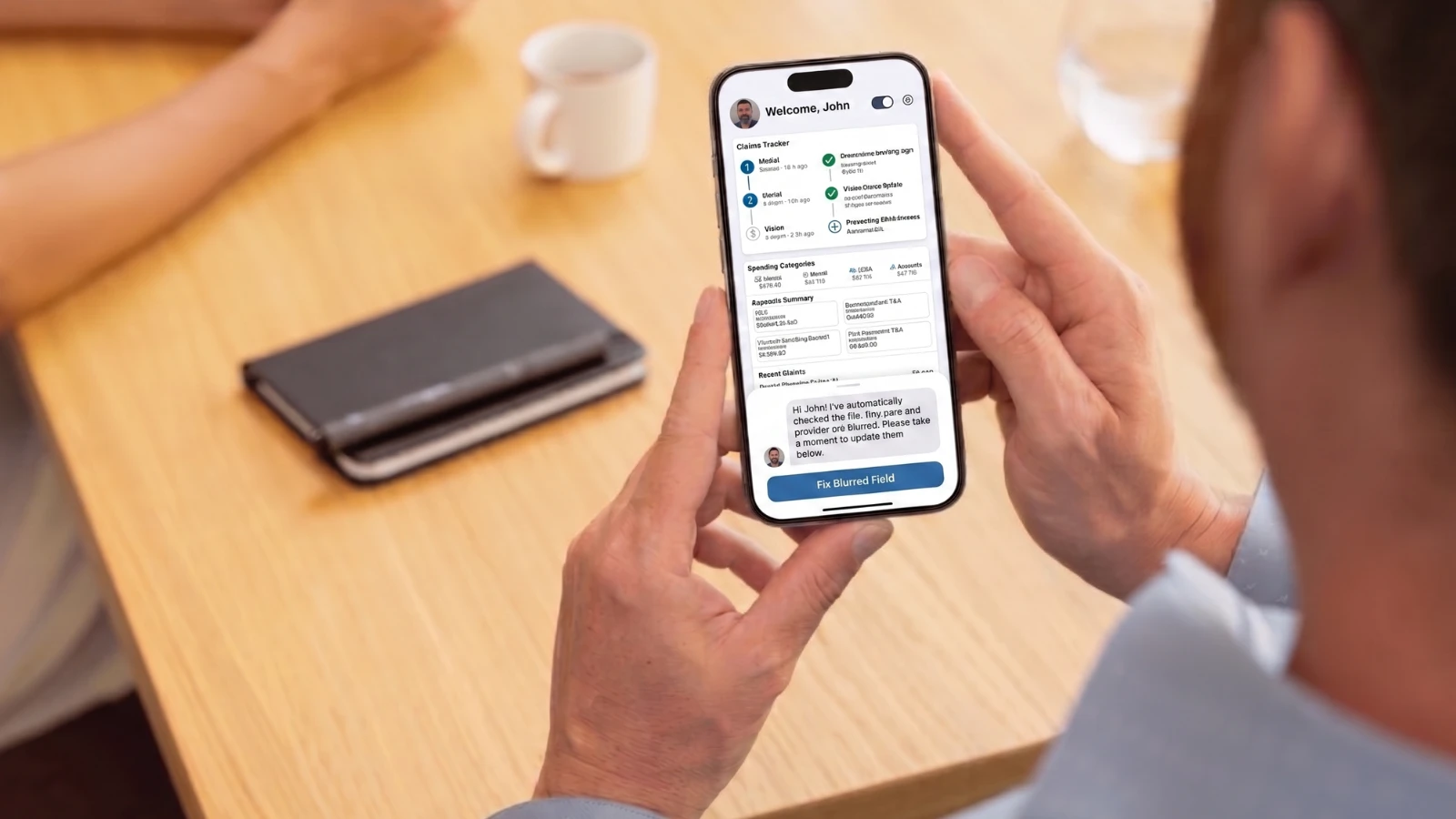
We brought AI into this problem as a way to give HR and brokers direct control over their own data. Instead of returning a generic "file failed" message, our system analyzes the file and surfaces the exact row, column, and field that is causing the issue. An admin can see that in the dashboard, fix it in place, and move on. What used to require a week of coordination can become a task that takes a few minutes.
This is a good example of what I believe AI should be doing in benefits. It should quietly remove technical obstacles and reduce the need for manual translation. When the infrastructure is easier to work with, HR teams and brokers can spend their energy on plan design, communication, and strategy, which are the areas where their judgment and experience are irreplaceable.
A future defined by usability and trust
For many people, benefits have never fully felt like something built on their side. They have often shown up as a set of rules to navigate and systems to interpret, usually at moments when people already have a lot on their minds. That makes it understandable that employees can be cautious about any change, especially when new technology is involved. I see AI as a chance to rebuild confidence in benefits, not strain it further. When it is used to make information clearer, processes faster, and outcomes more predictable, it can strengthen trust on both sides of the benefits equation.
At Lively, we use AI to make the experience more practical and dependable for everyone involved. For employees, that means clearer information at enrollment and fewer surprises when they submit claims. For HR teams and brokers, it means more reliable data and a platform they can stand behind when they are talking to their employees and clients. There is a line we have drawn and intend to keep. AI can and should inform decisions, surface issues quickly, and handle routine work in the background. What it should not do is make irreversible decisions about someone's access to care without a person reviewing and owning that decision.
As AI plays a bigger role across the industry, we are focused on using it to make benefits easier to understand and more responsive, so people feel that the system is working with them, not against them, and can trust that it will be there when it matters most.

Alex Cyriac
Alex Cyriac is the Co-Founder and CEO of Lively. Prior to Lively, Alex was the Head of Operations at Justworks Inc., a payroll, benefits, and compliance company in New York City (over $90M raised in venture capital). Prior to Justworks, Alex was the VP of Business Development North America at Worldpay (NYSE:WP). Alex holds a degree in Computer Science from the University of California, Santa Barbara.

Benefits
2026 Maximum HSA Contribution Limits
Lively · February 1, 2025 · 2 min read
For 2026, the HSA contribution limits are $4,400 for individual coverage and $8,750 for family coverage. These limits increased from 2025, when the caps were $4,300 and $8,550. If you’re age 55 or older, you can still contribute an additional $1,000 as a catch-up contribution.

Benefits
What is the Difference Between a Flexible Spending Account and a Health Savings Account?
Lauren Hargrave · February 9, 2024 · 12 min read
A Health Savings Account (HSA) and Healthcare Flexible Spending Account (FSA) provide up to 30% savings on out-of-pocket healthcare expenses. That’s good news. Except you can’t contribute to an HSA and Healthcare FSA at the same time. So what if your employer offers both benefits? How do you choose which account type is best for you? Let’s explore the advantages of each to help you decide which wins in HSA vs FSA.

Health Savings Accounts
Ways Health Savings Account Matching Benefits Employers
Lauren Hargrave · October 13, 2023 · 7 min read
Employers need employees to adopt and engage with their benefits and one way to encourage employees to adopt and contribute to (i.e. engage with) an HSA, is for employers to match employees’ contributions.
Benefits
2026 Maximum HSA Contribution Limits
Lively · February 1, 2025 · 2 min read
For 2026, the HSA contribution limits are $4,400 for individual coverage and $8,750 for family coverage. These limits increased from 2025, when the caps were $4,300 and $8,550. If you’re age 55 or older, you can still contribute an additional $1,000 as a catch-up contribution.
Benefits
What is the Difference Between a Flexible Spending Account and a Health Savings Account?
Lauren Hargrave · February 9, 2024 · 12 min read
A Health Savings Account (HSA) and Healthcare Flexible Spending Account (FSA) provide up to 30% savings on out-of-pocket healthcare expenses. That’s good news. Except you can’t contribute to an HSA and Healthcare FSA at the same time. So what if your employer offers both benefits? How do you choose which account type is best for you? Let’s explore the advantages of each to help you decide which wins in HSA vs FSA.
Health Savings Accounts
Ways Health Savings Account Matching Benefits Employers
Lauren Hargrave · October 13, 2023 · 7 min read
Employers need employees to adopt and engage with their benefits and one way to encourage employees to adopt and contribute to (i.e. engage with) an HSA, is for employers to match employees’ contributions.
SIGN UP FOR OUR
Newsletter
Stay up to date on the latest news delivered straight to your inbox